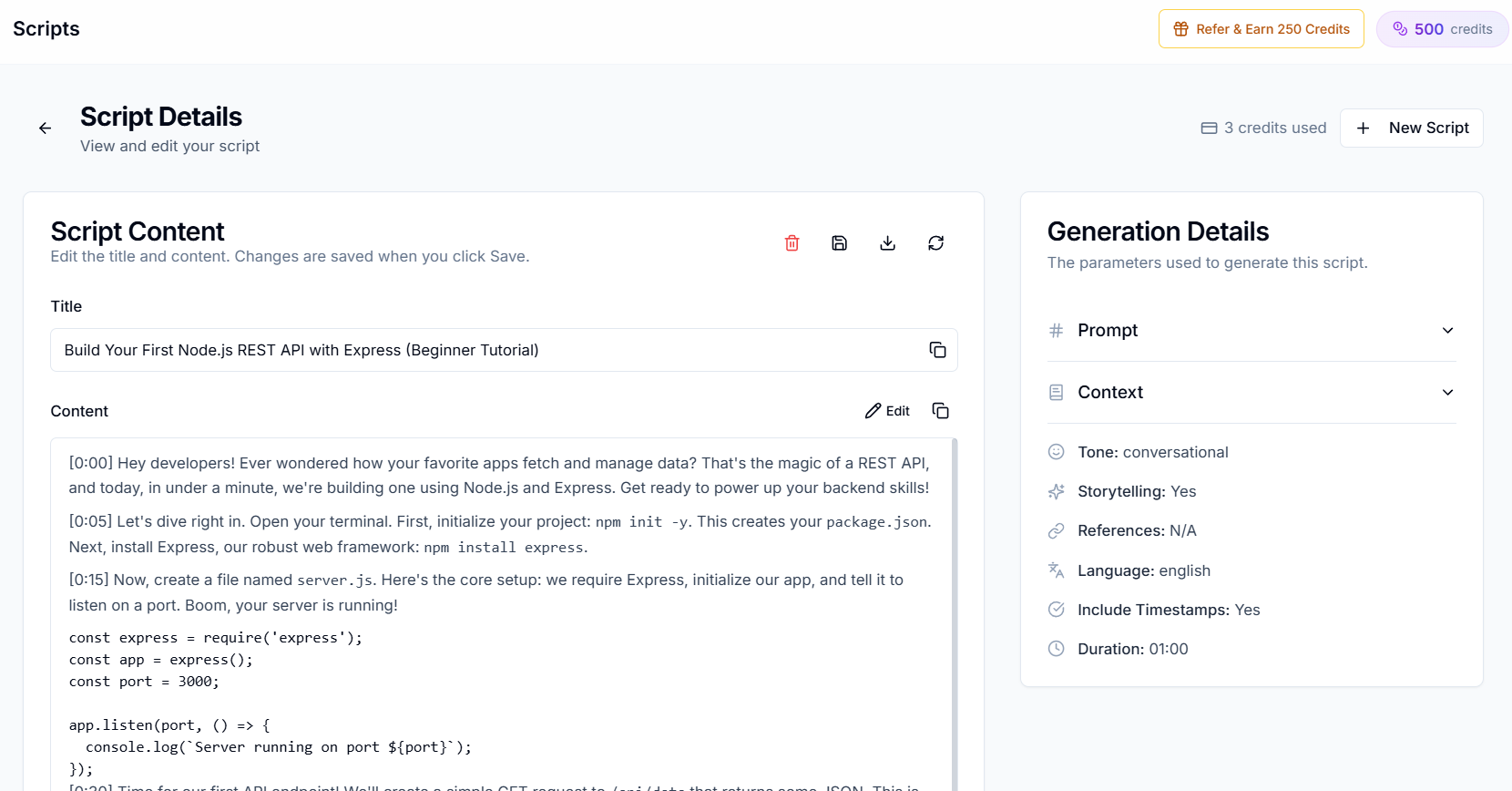
What should a YouTube Shorts script generator actually produce? A timed beat sheet, not an outline. A useful youtube shorts script generator writes a pattern-interrupt hook for the first 1.5 seconds, two or three retention beats, a payoff and a single small CTA, totalling roughly 45 to 110 spoken words for a 20 to 45 second runtime. Anything that hands you a paragraph of prose has written a blog post in a vertical aspect ratio.
Most short-form scripts do not fail at the idea. They fail in the first second and a half, before the idea has been stated.
That is the whole game, and it is why a long-form script trimmed to thirty seconds almost never works. A long-form viewer clicked; they have already agreed to give you a minute. A Shorts viewer agreed to nothing and is holding a scroll gesture.
Why Shorts Scripts Are a Different Job
Three structural differences change everything about how the script is written.
The audience has not opted in. In long-form, the thumbnail and title did the persuading and the script picks up afterwards. In the Shorts feed the script is the thumbnail. Your first line has to do the job the packaging normally does.
The dominant metric is the swipe. Completion rate and swipe-away rate drive distribution in the feed. That means the cost of a slow opening is not a slightly lower average view duration, it is that the video stops being shown.
Retention behaves differently. Shorts see high average retention overall, partly because the format is short and partly because the people who stay past the hook usually stay to the end. The consequence is blunt: nearly all of your losses happen in the first three seconds, so that is where the writing effort belongs.
Any youtube shorts script generator that ignores those three facts is producing a long-form outline with fewer words in it.
The 5-Beat Shorts Script Structure
This is the shape the good tools output and the shape to demand from the ones that do not.
| Beat | Timing | Job | Words |
|---|---|---|---|
| Hook | 0.0 to 1.5s | Pattern interrupt, open loop or bold claim | 5 to 10 |
| Setup | 1.5 to 5s | Why this matters, stated once | 10 to 15 |
| Beats | 5 to 25s | Two or three concrete points, no padding | 25 to 60 |
| Payoff | 25 to 35s | Close the loop you opened | 10 to 20 |
| CTA | Final 2s | One instruction, small | 3 to 6 |
Two rules govern the whole table. The loop opened in the hook must close in the payoff, or the viewer feels cheated and the next Short from you starts at a deficit. And the setup is where amateur scripts bloat, because explaining context feels responsible; in short-form it is the most common reason people leave.
5 Hooks That Survive the Swipe Test
Every hook worth writing does one of five things. These are the patterns worth feeding into a script tool as a constraint, rather than hoping it invents one.
1. The contradiction. "Everything you've been told about morning routines is backwards." Sets up a gap between belief and claim, and the viewer stays to see which one loses.
2. The mid-action open. Start already doing the thing. No greeting, no "in this video". The absence of context is itself the hook, because the brain wants the missing frame.
3. The stakes number. "This one setting cost me 40,000 views." Specific figures outperform vague ones consistently, and a number in the first line is the cheapest credibility available.
4. The direct question with a wrong default. "Do you know why your Shorts stop at 200 views?" It works because most viewers have a guess and want it confirmed or destroyed.
5. The visible payoff promise. Show the finished result first, then explain it. Common in cooking, design and build content for the obvious reason that the proof arrives before the argument.
Notice what none of them do: introduce the creator, name the topic in a neutral way, or say "today". A youtube shorts script generator that opens with "In this Short, we'll look at…" has written beat two and skipped beat one entirely.
What to Demand From a YouTube Shorts Script Generator
Judge tools in this category on four things, in this order.
- Timed output, not prose. Beats with seconds attached. If you have to guess where 1.5 seconds falls in a paragraph, the tool has moved its job onto you.
- Word count discipline. A generator that returns 250 words for a 30-second Short does not know the format. Delivery runs at roughly 140 to 150 words per minute.
- Hook variants. One hook is a guess. Five hooks against the same body is a test, and hook testing is the single highest-leverage thing in short-form.
- Your voice, not a presenter voice. Short-form amplifies stiffness because there is no room for a viewer to acclimatise. Tools that train on your existing videos start ahead here, which is the same argument we made in how AI learns your channel voice.
The Tools, Briefly
Creator AI. Disclosure: ours. It writes Shorts scripts against the voice profile built from your uploads, returns hook variations, and carries the same idea into thumbnails and subtitles. Free tier is 500 credits monthly, no card. Weakest point: the channel-training step means the first script is not instant.
vidIQ. Solid YouTube-native structure on a free credit allowance, and its keyword data is genuinely useful for Shorts topics that also serve search. Voice is generic by default.
Restream. Free, no account, fast. Good for generating twenty hooks to choose from; not a finished script.
Fliki and similar faceless-Shorts tools. These write the script and assemble the video. Convenient when you are not on camera, but script quality is subordinate to the auto-edit, and the output voice is nobody's.
ChatGPT. Will write a Short if you specify the beat structure and word count in the prompt yourself. Without that, it defaults to essay rhythm. Useful for rewriting a hook you already like.
Where Shorts Fit in the Actual Business
Worth saying plainly, because it changes how much time this deserves. Reported Shorts RPM in 2026 commonly sits in the low single-digit cents per thousand views, against several dollars for long-form; vidIQ's monetization breakdown puts the gap in that range. Shorts are a discovery channel, not a revenue line.
That is an argument for writing them fast, not for writing them badly. The correct allocation is most of your script effort on the first three seconds, minimal effort on everything else, and no effort at all on the elaborate CTA.
The Test That Settles It
Record the first three seconds only. Watch it back on your phone, in the feed, with the sound where you would normally have it.
If you would not stop, no tool downstream fixes that. If you would, the rest of the script is comparatively easy, and that is precisely the part a youtube shorts script generator is good at handling for you. The generator's job is to make hook testing cheap enough that you actually do it, then to fill in the beats fast so the twenty minutes you have goes into filming rather than typing.
Pair this with story structure for retention if you also publish long-form, since the same open-loop discipline runs both formats at very different speeds.
Keep Reading
- How to Write YouTube Scripts That Get More Views
- 7 Best Free AI Script Generator Tools for YouTube (2026)
- How to Improve YouTube Audience Retention and Watch Time
- Generate hook variations against your own channel voice, start free or compare plans.
- References: YouTube for Creators, YouTube Shorts monetization, vidIQ on Shorts RPM.