What is an AI that learns your voice? It is a tool that builds a persistent profile from your actual uploads, vocabulary, sentence length, humour, pacing and how you open and close, and then generates inside those constraints. It is not a prompt that says "write casually". The distinction matters because a prompt resets every session and a profile does not.
Your Voice Is Your Brand, and Most AI Tools Erase It
On YouTube, your voice is everything. It's what makes viewers subscribe, come back, and feel connected. It's why people watch you instead of the thousands of other creators covering the same topics.
So when an AI tool strips that voice away and replaces it with generic corporate-speak, it's not just a bad script, it's a brand risk. An ai that learns your voice from real videos is the difference between a tool that protects that brand and one that quietly flattens it.
What an AI That Learns Your Voice Actually Analyses
Step 1: Connect Your Channel
The process starts when you connect your YouTube channel to Creator AI. No complicated setup, just authorize the connection and select 3 to 5 videos that best represent your style.
Step 2: Deep Content Analysis
Creator AI's AI doesn't just skim your videos. It performs a deep analysis across multiple dimensions:
Linguistic Analysis
- Vocabulary frequency and word choice patterns
- Average sentence length and structure
- Use of slang, jargon, or niche terminology
- Transition phrases and connectors
Tonal Analysis
- Emotional range (motivational, humorous, serious, etc.)
- Formality level
- Use of rhetorical questions
- How you address your audience (direct, casual, professional)
Structural Analysis
- How you open your videos
- Your transition patterns between sections
- How you build to key points
- Your closing style and CTA placement
Step 3: Voice Profile Generation
All of this data gets synthesized into a Voice Profile, a mathematical representation of your content style. Think of it like a fingerprint for your creative voice.
This profile is persistent. It lives in your account and is applied to every piece of content you generate.
Step 4: Generation with Voice Matching
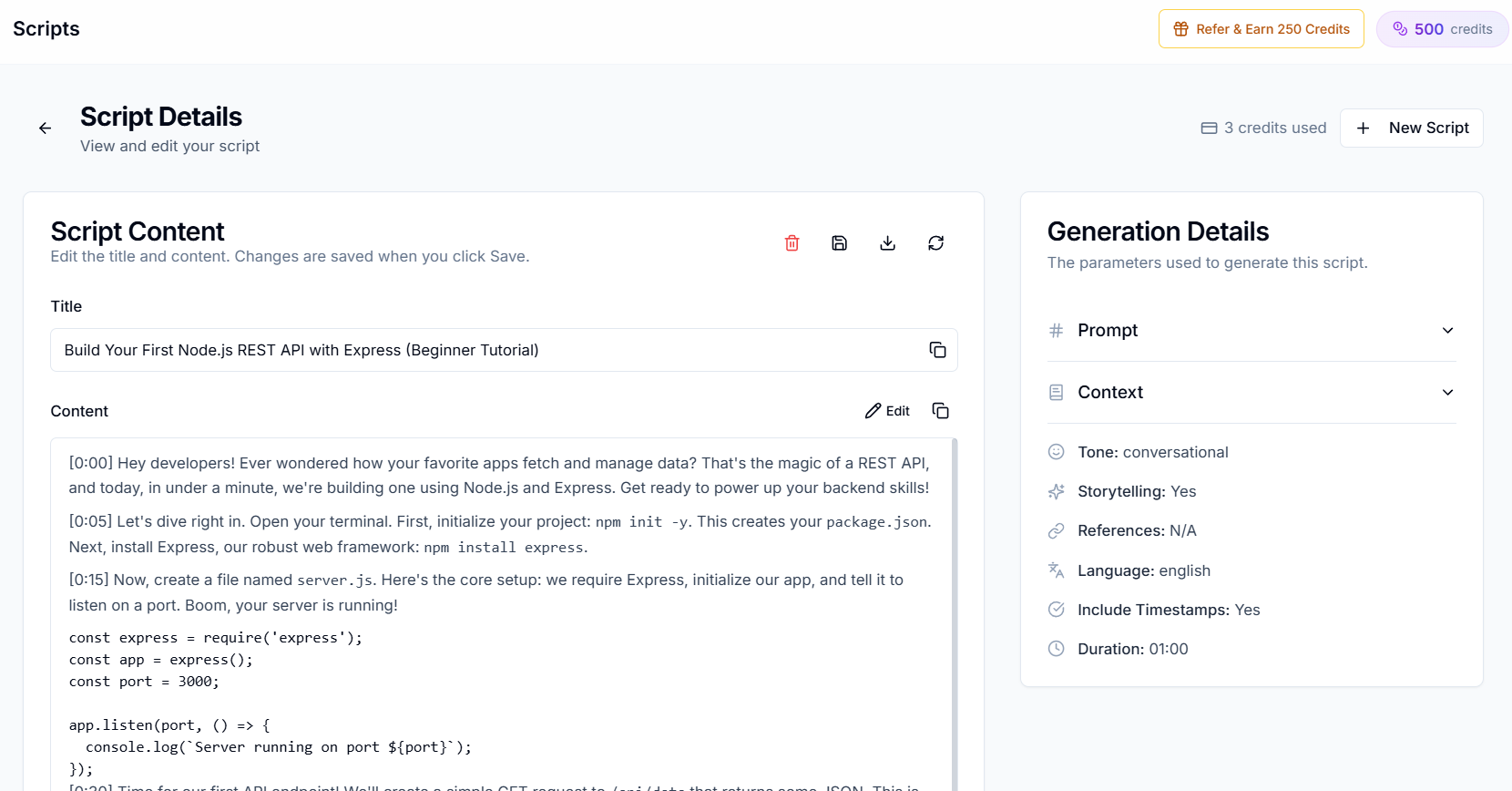
When you create a script, Creator AI uses your voice profile as a constraint on the generation process. Instead of producing generic output and then trying to adapt it, it generates content that's born in your style from the first word.
Why This Matters
Audience Trust
Your subscribers can tell when something doesn't sound like you. AI-sounding content erodes trust and can feel like a betrayal. Voice-matched content preserves the relationship.
Brand Consistency
Every video reinforces your brand. If your voice fluctuates wildly because you're using generic AI tools with different prompts each time, your brand becomes inconsistent.
Time Savings Without Compromise
The whole point of using AI is to save time. But if you spend 30 minutes editing a generic script to sound like you, you haven't saved much. Creator AI's voice matching means the first draft is 90%+ ready, cutting your editing time dramatically.
Which AI Script Tools Genuinely Train on Your Videos?
This is the question the marketing copy obscures. "Learns your brand voice" can mean four very different things, and only one of them survives a new session.
| Tool | What it actually trains on | Persists between sessions | Improves with more videos |
|---|---|---|---|
| Creator AI | Your uploaded videos, analysed for vocabulary, pacing, structure | Yes, stored voice profile | Yes |
| ChatGPT | The text you paste this session | No, resets | No |
| Claude | The text you paste this session, larger window | No, resets | No |
| Jasper | A brand-voice document you write and maintain | Yes, but it is your description, not your speech | Only if you rewrite it |
| Subscribr | Transcripts you supply per project | Partly, per project | Manually |
| vidIQ | Nothing, it optimises titles and tags | n/a | n/a |
The dividing line is the input. A tool trained on a description of your voice can only be as accurate as your ability to describe yourself, and most creators describe an idealised version. A tool trained on your uploads has no such gap: it is copying what you already do on camera, including the parts you would never think to write down.
The second dividing line is decay. Prompt-based tools start from zero every session, so script twelve sounds nothing like script three. That inconsistency is more damaging than any single mediocre draft, because your audience notices the drift long before they can name it.
Generic AI vs Creator AI: Voice Comparison
| Dimension | Generic AI (ChatGPT, etc.) | Creator AI |
|---|---|---|
| Voice source | User's text prompt | Your actual videos |
| Personalization depth | Surface-level tone | Vocabulary, pacing, humor, structure |
| Persistence | Resets each session | Permanent voice profile |
| Improvement over time | None | Gets better as you add more videos |
| Audience authenticity | Low, sounds AI-generated | High, sounds like you |
Why an AI That Learns Your Voice Beats One That Learns Your Topic
Most "AI for creators" pitches stop at the topic: give it a subject, get back words. But topic is the easy part, a hundred channels can cover the same subject. What separates you is delivery, and delivery is voice. When you use an ai that learns your voice instead of just your topic, three things change.
First, retention holds. Viewers stay for the person they subscribed to, and a script that mirrors your real cadence keeps that promise from the first line. Generic phrasing, by contrast, creates a subtle mismatch that pushes people to click away, and YouTube's systems read that drop-off as a signal to stop recommending you.
Second, output gets faster without getting blander. The reason a voice profile matters is that once an ai that learns your voice has one, the first draft already sounds like you, so editing shrinks from a rewrite to a polish. You keep the time savings of automation without paying for it in authenticity.
Third, consistency compounds. Every video that sounds unmistakably like you strengthens the brand; every off-voice one dilutes it. A persistent profile means the tenth script is as on-voice as the first, which is exactly what a generic chatbot, resetting every session, can never promise. That durability, more than any single feature, is what separates an ai that learns your voice from one that merely imitates it for an afternoon.
Get Started
Connecting your channel takes less than 2 minutes. The voice analysis runs automatically in the background. By the time you're ready to generate your first script, Creator AI already knows how you talk.
The best part is that the profile is never "done." Every video you add sharpens it, so an ai that learns your voice compounds over months instead of resetting every session like a generic chatbot. A creator who connects five videos today and another ten over the next quarter ends up with a profile that captures not just how they sound, but how their style is evolving. That is the quiet advantage: while other creators re-explain themselves to a blank prompt every single time, your tool already remembers, and every script ships closer to camera-ready. Over a year of uploads, that saved editing time and consistent on-brand voice add up to a real, compounding lead, the kind that's very hard for a competitor on generic tools to close. The earlier you start feeding the profile, the bigger that head start becomes, so the best time to connect your channel is before your next upload, not after.
That's not just convenience, it's a competitive advantage.
Keep Reading
- How to Make AI Scripts Sound More Human on YouTube
- ChatGPT vs a Dedicated YouTube AI Tool: Which Wins?
- Connect your channel in minutes, explore features and start free.
- See how channel data is surfaced in YouTube Analytics.